Transcript
Announcer:
You’re listening to VacciNation on ReachMD, and this episode is sponsored by CLS Seqirus. Here’s your host, Dr. Charles Turck.
Dr. Turck:
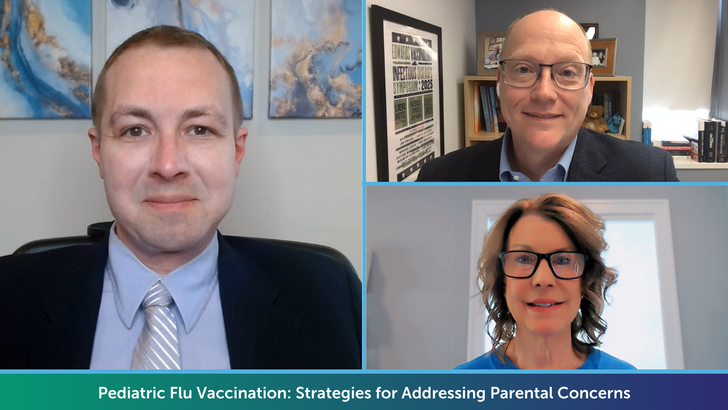
Welcome to VacciNation on ReachMD. I'm Dr. Charles Turck, and joining me to discuss parental concerns about pediatric influenza vaccination and strategies for addressing them are Drs. Buddy Creech and Wendy Wright.
Dr. Creech is Professor of Pediatrics at Vanderbilt University Medical Center in Nashville, and he's also the Director of the Vanderbilt Vaccine Research Program and leads NIH- and CDC- funded vaccine safety efforts. Buddy, thanks for being here today.
Dr. Creech:
I'm glad to be here.
Dr. Turck:
And Dr. Wright is a board-certified adult and family nurse practitioner based out of Amherst, New Hampshire, as well as the owner of the Wright and Associates Family Healthcare. Wendy, it's great to have you with us as well.
Dr. Wright:
Thank you so much. I'm looking forward to this today.
Dr. Turck:
So Buddy, I'll start with you. Compared to other childhood vaccines, where do flu shots stand in the terms of uptake? And what do you see as the most common reasons parents hesitate?
Dr. Creech:
Yeah, it’s not great compared to others. So for some vaccines, we enjoy 80 to 90 plus percent coverage in many areas around the United States, but when we look at the uptake of flu vaccine, it's typically less than half of children who take advantage of flu vaccine.
Now, there's a lot of reasons for that. One of the most common reasons for that is that people tend to sleep on influenza. They treat it maybe as the mild respiratory infection that we know that it can be. Maybe they don't understand. Parents don't quite get the fact that it can also be a severe infection that leads to the death of somewhere between 150 to 300 children a year.
So I think there's a combined issue there. There's an issue of it not being required for certain school activities and maybe a sense that it's milder an infection than some of the other things we're trying to prevent in childhood. And then maybe last, it just takes extra work to get a flu vaccine. It's not quite as easy as going in for the annual checkup; you have to go at a different time of year.
So I think, taken together, only about half of our children are protected against influenza each year.
Dr. Wright:
Buddy, we see the same thing in our family practice in New Hampshire. And I can't echo your sentiment enough. I think if we look at last year, for instance, with flu, most of the children that died as a result of influenza were actually otherwise healthy and unvaccinated.
And we see this a lot, that parents have this sense that it's really not a serious illness, and my kid is otherwise healthy. So I think that's a really important point to take away. And I cannot emphasize enough how much hesitancy we are seeing across all vaccines. And I think flu is getting hit pretty hard in terms of parental refusal.
Dr. Turck:
Now, Wendy, I'd like to dig a little bit deeper into a couple of the concerns that parents have, given that some parents still reference mercury or preservatives. Would you explain the ACIP recommendations on thimerosal removal, what brought those about, and how you address those concerns in a reassuring way?
Dr. Wright:
Yes, I'd love to talk about thimerosal, because in terms of my opinion on it, it was a more ceremonial headline getter, in my opinion, than really some change in what we have been doing.
The reality is that thimerosal is a preservative, and generally it's only used in multidose vials of influenza. Most of us in practice are using single-dose entities. So in my clinic, there's not a vaccine in my clinic that contains thimerosal.
Now, with that said, there are agencies such as in the public health domain or maybe long-term care facilities where they do use multidose vials to vaccinate larger numbers of individuals. But I really believe that parents should know that most of us in practice have not been using any multidose vials for decades.
Dr. Turck:
Now, Buddy, we also know that many parents’ feelings about vaccines changed during the COVID-19 pandemic, with some becoming more cautious and less trusting of public health guidance. So how have you seen that play out in your practice when it comes to the flu shot? And what's helped you rebuild that trust?
Dr. Creech:
I think there's a couple of things that go into that. We know that when hesitancy occurs or fear occurs to one vaccine, it really threatens to knock down a lot of other dominoes. We see that in a variety of places. We see it internationally. When there's concern about one, it spills over to the others. And you're exactly right; there's a lot of confusion, and with some parents, concern, about COVID-19 vaccinations. We see even now, a split recommendation from the American Academy of Pediatrics and the ACIP as to who should receive COVID vaccine.
I think one of the challenges as we look back at the pandemic is that we probably did some of our recommendations—we probably gave those with maybe too heavy of a hand. What I find gives a lot of purchase to families is to say, “I wish we could do parts of the pandemic over again. I wish we could run it back and have a do-over, call a mulligan, and make some different choices, but we were trying to make the best decisions we could at the moment.” So sometimes what I will say is, “It's okay to think differently about COVID vaccine. Let's put that on the shelf for the purpose of this discussion, and let's just talk about influenza vaccine on its merits.”
What I'm finding right now is that in a variety of places, the more I'm able to honor an individual parent's desire for freedom to make a choice and this idea of purity—meaning what's in the vaccine, how's it going to affect my child—if I lean into those two domains, rather than focusing on how it might help other people or how it's fair for us to get this vaccine, if I lean into liberty and into purity, parents start to know that I'm talking their language, and we start to get a little movement, not just for flu but for other vaccines as well.
Dr. Turck:
For those just joining us, this is VacciNation on ReachMD. I'm Dr. Charles Turck and I’m speaking with Drs. Buddy Creech and Wendy Wright about how to overcome parental hesitancy toward pediatric influenza vaccination.
So Wendy, now that we've discussed some parental concerns, let's talk more about optimizing communication and increasing uptake. Knowing that the CDC recommends children six months and older get vaccinated against the flu, what practical steps can we take to help more parents follow through on that recommendation?
Dr. Wright:
Thank you so much, because this was my doctoral work: how do we as providers—using language, using behavior—get these vaccines into the arms of our patients?
First thing that I think is really helpful is to set the stage in the summer months—as we're seeing parents and we're seeing kids, to say, flu vaccines will be coming out in early September, just so you're aware. One of the things I do as soon as flu vaccines hit my clinic is I use a broadcasting system where I actually record
my voice. I run a report of individuals in a particular age group, and I record a message that goes out to every single patient in my clinic, so that they know that those vaccines are available and that I recommend them. But to our listeners, one of the most important things that we can all do is use what we call a strong recommendation. There are two different types of recommendations. There are presumptive, often used interchangeably with a strong recommendation. That's what works.
Presumptive means you say something to a parent like, “I see that your child is due today for the flu vaccine. He has asthma.” I personalize the message. “It is really important that we get that on board today and we've got it in the clinic. Can I go pull that vaccine and we'll do it while we have you here?”
That's very different than a participatory recommendation, where you say, “What do you think about getting your flu vaccine for your son today?” We know that when people use a strong recommendation—and make no bones about it, study after study has shown that we are the most trusted authority, the provider, whether that be the physician, the nurse practitioner, the PA, the nurse—when we give that strong recommendation, we have the best chance of getting those vaccines into the arms of our patients.
And I would just add one other thing—we send out a portal blast in addition to a phone call, and we look at vaccination status at every single visit. I don't care why you're here, we're not going to wait until you get to your well visit. We're going to lose so many vaccine opportunities. Those are all best vaccine practices that really can turn the tide in terms of declining vaccination rates.
Dr. Turck:
Now, before we wrap up our program, I'd like to ask each of you one more question. Buddy, starting with you, when you're talking with a hesitant parent, what communication approaches have you found most effective in keeping the conversation open and productive, especially when addressing misinformation or deeply held concerns?
Dr. Creech:
Yeah, I think it's really important that we level set and say that we want the same thing. I want their child to be healthy, safe, and protected from bad outcomes. And it turns out that's what parents want too, with even more skin in the game than I have. So we usually just level set and say we want the same thing. We're going about it in different ways. How are we going to get there?
What Wendy referenced with the presumptive approach is so critical, because if we don't have confidence in it, certainly our patients aren't going to have confidence. And that's not just with the clinician. That's also with the front staff. It's with others in the office setting, to make sure that you don't have any weak links in that chain of being confident of what we're doing. So that's number one, is to remind parents that we want the same thing.
The second one is to really avoid situations where it appears that I'm being dogmatic, heavy handed, or overly paternalistic. We're in this together, so let's have a conversation. So I try to avoid situations where I'm coming across as an expert to their non-expert.
Now, sometimes you just have to get there, right? When I go to the mechanic and they tell me I need new brakes, I don't argue and say, no, I think I'm going to get new tires instead. I have to, at some level, submit to the recommendation of people who are expertly trained or knowledgeable about a situation. But if you lead from that heavy handedness, sometimes that can backfire.
The third is, is I try to avoid sort of the dramatizations that we would like to rely on, because it turns out when we overdramatize the bad outcomes that might occur, parents actually dig in more deeply as if they're being manipulated. So I try to avoid manipulation. I try to honor where they're coming from.
And then I try to use what the ancients would call counter catechesis, and that means where we say, “You've heard it said that, but I'm going to tell you something different.” So you may have heard that influenza vaccine causes influenza disease, but I tell you that that's actually impossible because of how the vaccine is made. Or you may have heard that the side effects of influenza vaccine are worse than the probable outcomes from influenza disease, but I tell you, over 200 kids a year die of influenza, and many thousands of children are admitted to the hospital because of influenza and its complications.
That sort of going back and forth is really important. And then I'll end with this—this takes time. I know everyone has like eight minutes to see a patient in their office. Maybe it's multiple visits. Maybe it's over multiple years. Don't give up, stay patient, and work with them.
Dr. Turck:
And Wendy, you touched on a couple of these already. But are there any other changes in primary care workflows that could help make flu vaccination feel like an expected part of child health visits, rather than an optional extra?
Dr. Wright:
Yeah, I think you've heard it reiterated throughout this interview, but there are a couple of other things—having EHR prompts. So one of the things we do is we have a care planning. A medical assistant care plans every chart before I see a patient and highlights what vaccines that child or adult is needing that day. So there are four eyes looking at that chart to make sure that we don't let any opportunity go by to vaccinate these children and our adult patients.
We use standing orders. So if they happen to be in for one vaccine and it's flu season, well, we're going to offer it while we have them there.
And one of the other things, because this is so important to me, is that when I hire staff, I want to know that even if that staff says, “I don't feel like the vaccine is important for me,” that that is never going to be stated to a patient. That we are all working as a team to ensure that we are giving evidence-based recommendations regardless of what someone chooses to do for their own children. But we see that a lot of times, staff members in offices often are counterproductive in terms of recommending vaccines. So we need to be into this game as a team and all of us working together if we are going to move that vaccine pendulum, which I think we can do again through personalized messages and strong recommendations.
And you know what? It’s their choice. At the end of the day, I can't make people do what I want them to do, but I want them to know that I heard them and that we'll talk about this at the upcoming visit.
Dr. Turck:
Well, with those recommendations in mind, I want to thank my guests, Drs. Buddy Creech and Wendy Wright, for joining me to discuss techniques for strengthening parental confidence in pediatric flu vaccines. Buddy, Wendy, it was great having you both on the program.
Dr. Creech:
Thanks so much for having us.
Dr. Wright:
Thank you. It's been my pleasure to be here.
Announcer:
This episode of VacciNation was sponsored by CSL Seqirus. To access this and other episodes in our series, visit VacciNation on ReachMD.com, where you can Be Part of the Knowledge. Thanks for listening!